
Many organisations can say that they use BIM.
They have modelling software. They employ BIM coordinators. They produce federated models, run clash-detection meetings and maintain project folders inside a common data environment. Their proposals mention digital delivery, coordination and ISO 19650.
All of this indicates BIM activity.
It does not necessarily indicate BIM maturity.
The distinction becomes visible when the organisation is placed under pressure. A large project begins and the standard templates no longer fit. An experienced BIM manager leaves. A client requests structured asset information. A new contractor joins with a different technology stack. Model responsibilities become contractual rather than informal.
Suddenly, practices that appeared established begin to fragment.
The organisation uses BIM. But BIM is not yet embedded in the organisation.
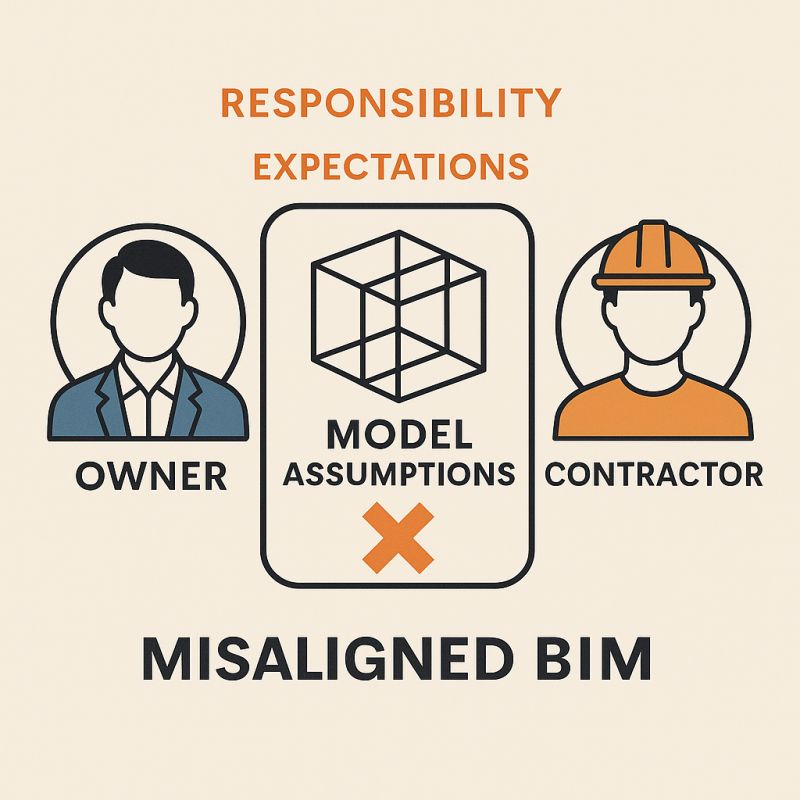 Maturity becomes visible when responsibilities, model assumptions and stakeholder expectations are made explicit.
Software adoption is not organisational capability
Software is the most visible part of BIM. It is also one of the easiest capabilities to purchase.
An organisation can acquire licences, workstations, collaboration platforms and model-checking applications within a budget cycle. It can train employees to operate them and produce impressive demonstrations.
None of this proves that the organisation can deliver controlled information consistently.
Organisational capability exists when technology is supported by defined responsibilities, repeatable workflows, appropriate information requirements, competent personnel, functioning quality controls, contractual clarity, management oversight and measurable performance.
Without these conditions, software increases production capacity but does not necessarily improve organisational control.
The India BIM Association’s Organizational Maturity Assessment Framework makes this distinction explicit. Technology represents 30 per cent of its provisional weighting, Process 45 per cent and Policy 25 per cent. The weights remain subject to consultation and pilot validation. The message is already clear: most BIM value and delivery risk sit outside the software itself.
The real test is consistency
A capable individual can make an immature organisation appear advanced.
An experienced BIM manager may create templates, repair models, resolve coordination problems and train colleagues informally. A strong modeller may discover workarounds that keep a difficult project moving.
The project succeeds because particular people know what to do.
The test is what happens when they are unavailable. Can another team reproduce the same standard? Are methods documented and maintained? Can management see where the process is failing? Are exceptions recorded? Does the organisation learn, or does the next project encounter the same failure?
Maturity means that good performance is not accidental.
Defined does not mean implemented
Organisations often possess more process documentation than operational control.
They may have a BIM manual, a standard BIM Execution Plan, a CDE procedure, naming conventions, a responsibility matrix, a quality checklist and a training programme.
These documents prove intent, not implementation.
The IBIMA framework distinguishes four evidence layers. Policies and templates show that a practice is defined. Project records and CDE logs show that it is implemented. Approval records, rejection logs and corrective actions show that it is controlled. Performance trends and reduced failure show that it is effective.
A documented process is not automatically an operating process.
A CDE is not a folder in the cloud
An organisation may own a recognised platform and still exchange information through email, informal messages and local folders. Files may reach the platform only after decisions have been made elsewhere.
Technically, the organisation has a common data environment. Operationally, it has cloud storage.
A mature CDE workflow controls how information moves through defined states such as work in progress, shared, published and archived. It establishes permissions, review responsibilities, authorization, revision control and a traceable record of exchange.
At higher maturity, the organisation also asks whether the workflow works: how often is information rejected, how long do approvals take, which errors recur and whether corrective actions are completed.
The platform enables the workflow. It does not create it.
A BEP is not organisational strategy
A BIM Execution Plan defines how information will be managed within a particular project or appointment. It can establish methods, responsibilities, standards and delivery procedures.
It is not a substitute for organisational direction.
A mature organisation also understands why it invests in BIM, which business outcomes it expects, who can make digital-delivery decisions, how resources are allocated, how performance is reviewed and how lessons move between projects.
Without this layer, each project invents its own version of BIM. The organisation accumulates experience without building institutional capability.
Maturity is broader than model production
The IBIMA framework examines ten capabilities across technology, process and policy:
- software;
- computing and field infrastructure;
- CDE workflow and collaboration;
- knowledge and enabling resources;
- activities, accountability and workflows;
- deliverables and Level of Information Need;
- leadership and governance;
- education, training and competence;
- standards, assurance and conformity;
- appointments and information obligations.
This breadth matters because the capabilities depend on one another. Excellent models can be undermined by weak appointment terms. A strong CDE cannot correct poorly defined deliverables. Extensive training does not guarantee competence.
The framework includes a balance rule: the reported overall level cannot sit more than one level above the weakest category. Strong technology therefore cannot conceal weak governance or process.
More detail is not automatically better information
Organisations sometimes demonstrate BIM ambition by requiring increasingly detailed models.
But model detail and information usefulness are not the same.
A mature requirement begins with purpose: what decision must the information support, who will use it, what geometry and alphanumeric information are necessary, which documentation must accompany it and how acceptance will be verified?
This is the logic behind the Level of Information Need.
A generic instruction such as “LOD 300” may sound precise while leaving essential questions unanswered. An organisation demonstrates maturity when it specifies and verifies information according to purpose, not when it produces the largest possible model.
Training is not proof of competence
Course attendance is often used as a proxy for capability. It should not be.
Training can provide knowledge. Competence also requires skill, experience, observed performance and judgement.
A mature organisation defines the activities that need to be performed, assesses whether the assigned people can perform them and manages gaps through supervised work, output reviews, practical assessment, mentoring and development.
The relevant question is not how many people attended BIM training. It is whether the organisation can demonstrate that people assigned to critical activities are competent.
Leadership cannot delegate maturity to the BIM team
A BIM department can develop templates, support projects, evaluate technology and improve model checking. It cannot independently resolve commercial responsibilities, change procurement policy, assign corporate decision rights or secure sustained investment.
These require leadership.
Management must decide what BIM is expected to achieve and how performance will be governed. It must allocate resources and ensure that HR, procurement, IT and project-delivery policies support the intended operating model.
Artificial intelligence, digital twins, immersive technology and automation are not universal maturity requirements. If a technology does not address a defined need or produce proportionate value, declining to adopt it can be a mature decision.
Maturity is demonstrated by the quality of the decision, not the novelty of the tool.
A maturity score is not the main result
Executives understandably want a number. A composite score can support internal baselining and repeated assessment. It can also create false confidence when separated from evidence and scope.
Two organisations can receive the same score while having very different weaknesses. Their investment priorities should not be identical.
The capability profile is therefore more useful than the headline score. It reveals what works reliably, where practices vary, where evidence is weak, which gaps create risk and where investment is likely to produce value.
Improvement should not begin automatically with the lowest score. Business criticality, risk exposure, dependencies, implementation effort and expected benefit also matter.
 The value of assessment lies in deciding what should improve next, not in displaying a score.
BIM maturity is not ISO 19650 certification
ISO 19650 establishes requirements and concepts for managing information using BIM. It does not create a universal organisational maturity ladder from Level 0 to Level 4.
An organisation may assess aspects of its maturity using principles aligned with ISO 19650. That assessment does not by itself establish conformity, and a BIM Maturity Index does not constitute certification.
The IBIMA framework makes this limitation explicit. Its relationship with ISO 19650 is requirement-based rather than level-based. Its comparison with the historical Bew-Richards levels is contextual, not an equivalence.
The framework is currently Version 1.0 Consultation. Its weights are provisional and intended for pilot testing across different types and sizes of organisations. Until that validation is complete, the capability profile is the primary result, not a national benchmark.
Evidence must be proportionate, not absent
A smaller organisation does not need the same volume of documentation as a large enterprise. It still needs control.
Proportionality means that the method and evidence reflect the organisation’s role, scale, complexity, information risk and consequences of failure. It does not mean maturity expectations disappear for smaller firms.
A facilitated workshop can support a preliminary self-assessment. It cannot produce an audit-ready conclusion. A more assured assessment requires representative evidence, interviews, live demonstrations, system records, project sampling and documented findings.
Maturity is demonstrated by normal practice, not selected examples.
The useful question is what should improve next
The purpose of maturity assessment is not to decide whether an organisation is “good at BIM.” It is to make the next improvement decision more defensible.
The immediate need may not be another software platform. It may be clearer information obligations, a controlled CDE workflow, verified competence, standardized quality checks or purpose-specific deliverables.
The framework turns “we use BIM” into harder questions:
- Is the capability defined?
- Is it implemented?
- Is it controlled?
- Is its effectiveness measured?
- Is it improved from evidence?
- Does it depend on particular individuals?
- What records support the claim?
- Which weakness creates the greatest business risk?
Using BIM means that digital methods are present.
Being BIM-mature means that the organisation can define, deliver, control, measure and improve those methods consistently.
One can be purchased. The other must be built.
Read and test the framework
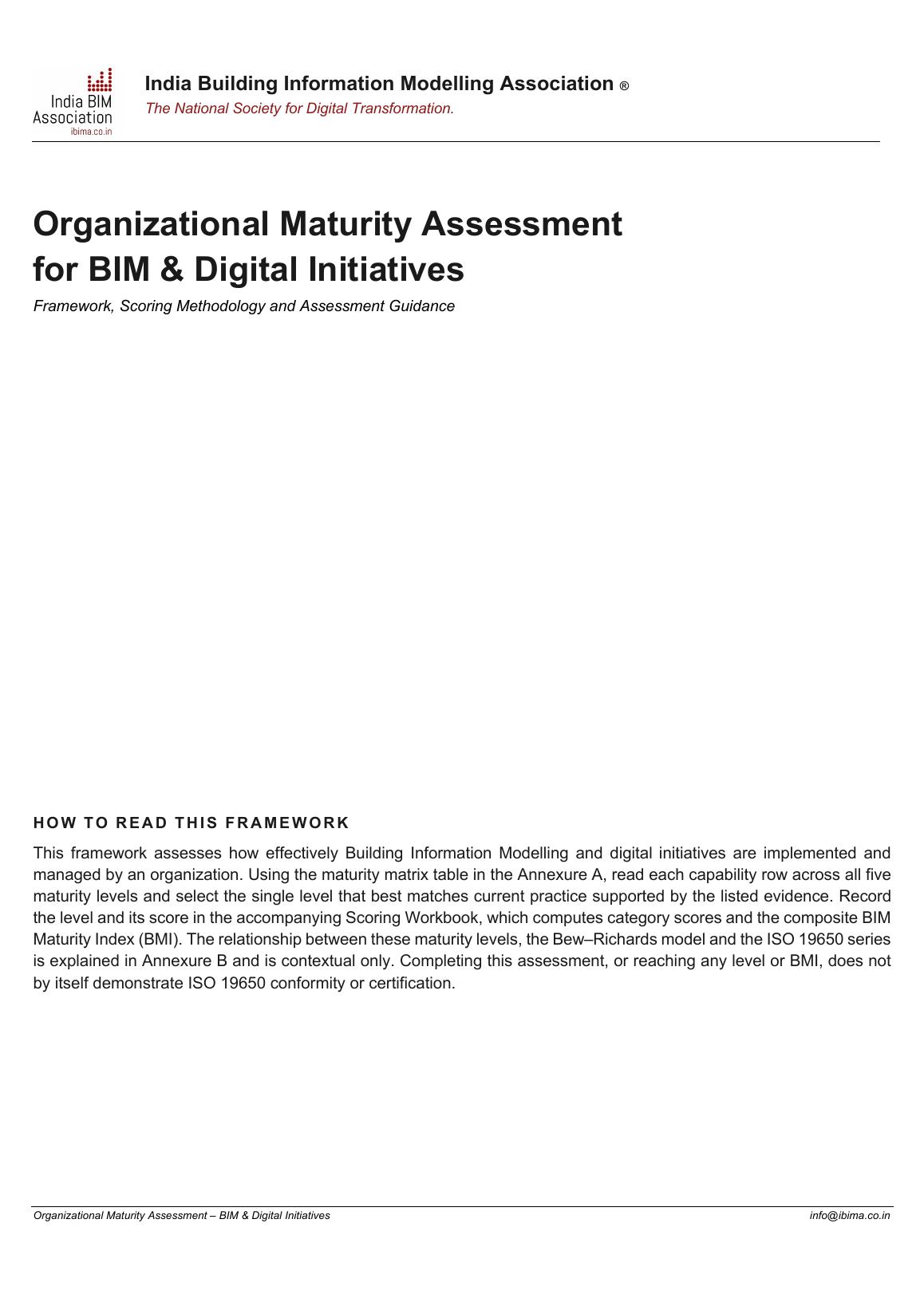 The Version 1.0 Consultation framework provides the assessment matrix, scoring method, evidence guidance and contextual relationship with ISO 19650.
Download the IBIMA Organizational Maturity Assessment for BIM & Digital Initiatives (PDF)
The framework is Version 1.0 Consultation and is open for non-commercial, public-benefit use, testing and feedback under its stated CC BY-NC-SA 4.0 terms. Completing it does not establish ISO 19650 conformity, certification or a national benchmark.